Under ₹30,000, two tablets stand out from the rest — and the gap between them and everything else is significant. Whether you need something for online classes, reading PDFs, or unwinding after a long day, this guide cuts through the noise and tells you exactly what to buy and why.
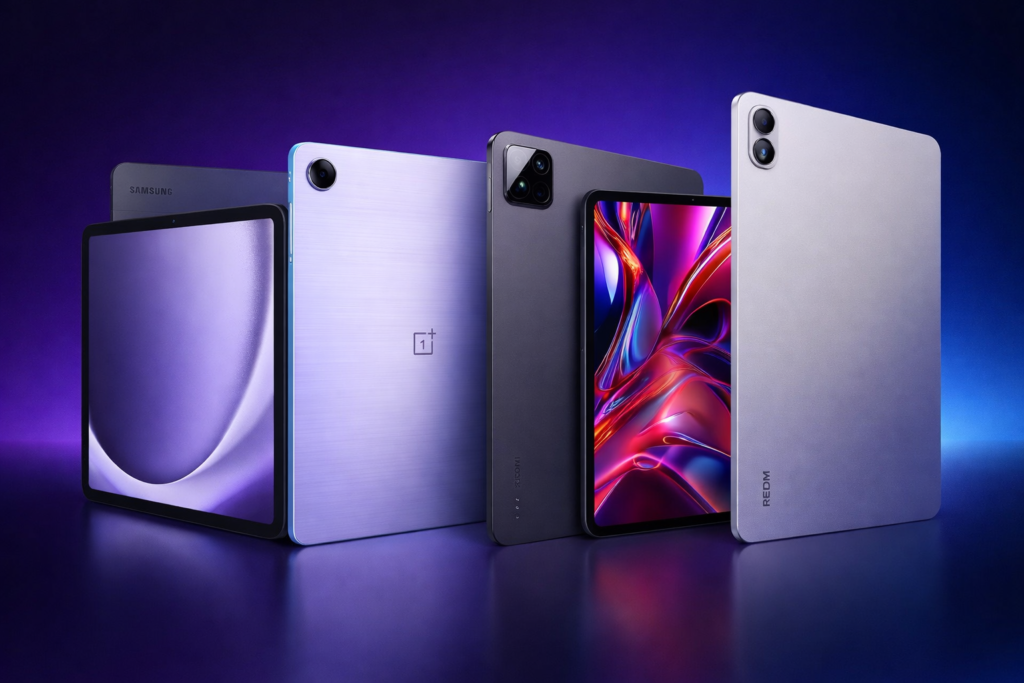
A good tablet under ₹30,000 in 2026 is not a compromise. It is a proper device with a large display, a battery that genuinely lasts all day, enough performance to handle study apps and streaming simultaneously, and in some cases a stylus for handwritten notes. The sub-₹30,000 Android tablet market in India has improved significantly in the last two years and the options available right now are legitimately good — but they are not all equally suited to every type of student.
We have reviewed the five best tablets for Indian students under ₹30,000 in 2026. Here is exactly what each one does well, where each one falls short, and which one is right for your specific situation.
Our Top Picks
- Best Overall: Xiaomi Pad 7
- Best Budget: Redmi Pad 2 Pro 5G
- Best for Note-Taking: Samsung Galaxy Tab S6 Lite (2024)
- Best for Entertainment: OnePlus Pad Go 2
- Best Value: Samsung Galaxy Tab A9 Plus 5G
Best Student Tablets Under ₹30,000 — Comparison Table
| Product | Display | Performance | Battery | Best For | Check Price |
|---|---|---|---|---|---|
| Xiaomi Pad 7 | 11.2″ 3.2K 144Hz LCD | Snapdragon 7+ Gen 3 | 8,850mAh, 45W | All-round student use | [Check Price on Amazon] |
| Redmi Pad 2 Pro 5G | 12.1″ 2.5K 120Hz LCD | Snapdragon 7s Gen 4 | 12,000mAh, 33W | Budget + massive battery | [Check Price on Amazon] |
| Samsung Galaxy Tab S10 FE | 10.9″ 2K 90Hz LCD | Exynos 1580 | 10,090mAh, 45W | S Pen note-taking | [Check Price on Amazon] |
| OnePlus Pad Go 2 | 11.4″ 2.4K 120Hz LCD | Dimensity 7300 Ultra | 9,510mAh, 33W | Streaming & OxygenOS | [Check Price on Amazon] |
| Samsung Tab A9 Plus 5G | 11″ 1920×1200 90Hz LCD | Snapdragon 695 | 7,040mAh, 15W | 5G + Samsung ecosystem | [Check Price on Amazon] |
Top 5 Tablets for Students Under ₹30,000 — Full Reviews
1. Xiaomi Pad 7 — Best Overall Student Tablet

The Xiaomi Pad 7 is the tablet that makes every other option in this price range justify its existence. An 11.2-inch 3.2K display with 144Hz refresh rate, Dolby Vision, and a certified low blue light hardware solution — for long reading and lecture-watching sessions, this screen genuinely reduces eye fatigue better than most alternatives. The Snapdragon 7+ Gen 3 handles everything a student throws at it without hesitation: multiple browser tabs, YouTube in the background, simultaneous note apps, office documents. It does not slow down.
For students taking handwritten notes, Xiaomi’s Focus Pen (sold separately) is compatible with 10x touch resolution. The 8,850mAh battery with 45W charging handles a long college day comfortably and tops up quickly when you get home. The 3.2K display is bright enough for outdoor use on a campus courtyard. HyperOS 2 on Android 15 is a capable daily driver, though it carries more visual complexity than OxygenOS. Current pricing starts at ₹28,399 with the lowest available on Amazon.
Worth knowing: Xiaomi just launched the Pad 8 in India (March 2026) at ₹33,999 — above this article’s ₹30,000 budget ceiling, but worth a look if you can stretch. It upgrades to the Snapdragon 8s Gen 4, UFS 4.1 storage, HyperOS 3 on Android 16, and brings the new Focus Pen Pro with 16,000+ pressure levels. If your budget allows, the Pad 8 is the stronger long-term investment. If ₹30,000 is the hard limit, the Pad 7 at ₹28,399 remains the right call.
Key Strengths
- 3.2K 144Hz Dolby Vision display — best screen in this price range for study and streaming
- Snapdragon 7+ Gen 3 — enough performance for demanding multitasking
- TÜV Rheinland Low Blue Light and Flicker Free certified — genuinely useful for long sessions
- 45W fast charging on an 8,850mAh battery — backs up a full day easily
- Wide colour gamut, HDR10, and Dolby Vision make it excellent for Netflix and content consumption
Pros
- Best display in the sub-₹30,000 tablet segment — not close
- Strong daily and multitasking performance
- Stylus compatible for note-taking (stylus sold separately)
- Thin, well-built chassis that does not feel like a budget product
Cons
- Stylus not included — adds to the total cost if you need it
- HyperOS is more visually busy than cleaner alternatives like OxygenOS
- No 5G option — Wi-Fi only
Best For: Students who study heavily, watch a lot of content, and want the best screen they can get under ₹30,000 — with a path to stylus note-taking if needed.
2. Redmi Pad 2 Pro 5G — Best Budget Pick with the Biggest Battery on This List

The Redmi Pad 2 Pro launched in India on January 12, 2026, and it immediately became the most compelling budget tablet in this price range. The headline spec is impossible to ignore: a 12,000mAh battery — the largest in any tablet under ₹30,000 in India right now. For a student who commutes, attends back-to-back lectures, and cannot always find a charging point, this is not just a feature. It is the entire buying decision.
The 12.1-inch 2.5K 120Hz display with Dolby Vision and triple TÜV Rheinland certification — Low Blue Light, Flicker-Free, and Circadian Friendly — is well-suited to long study sessions. The Snapdragon 7s Gen 4 is a meaningful upgrade over the previous generation’s 7s Gen 2, handling daily student tasks — apps, documents, video calls, streaming — comfortably. The quad Dolby Atmos speaker system with 300% volume boost is genuinely loud and clear for a tablet at this price.
Xiaomi also offers the Redmi Smart Pen (sold separately at ₹3,999) with 4,096 pressure levels and ultra-low latency — making handwritten notes a real option. The 27W reverse charging lets the tablet double as a power bank for your phone, which is an unexpectedly useful feature for students on long days. The Redmi Pad 2 Pro Wi-Fi starts at ₹24,999; the 5G variant at ₹27,999.
Key Strengths
- 12,000mAh battery — by far the largest battery in this roundup
- Snapdragon 7s Gen 4 — a notable chipset upgrade over its predecessor
- Reverse 27W charging — doubles as a power bank for other devices
- Smart Pen available separately for note-taking with 4,096 pressure levels
- 5 years of OS updates and 7 years of security patches — the longest update commitment on this list
Pros
- Best battery life in this segment — not close
- Large 12.1-inch screen with eye-care certifications for long study sessions
- 5G + eSIM support on the cellular variant
- Excellent update commitment — 5 years OS + 7 years security
Cons
- 120Hz refresh rate, not 144Hz — a minor step behind the Pad 7’s display smoothness
- Smart Pen sold separately — adds ₹3,999 to the cost for note-takers
- Larger 12.1-inch form factor is less compact for everyday carry
Best For: Students who need maximum battery endurance, a large screen for reading and streaming, and want a future-proof device with long software support.
3. Samsung Galaxy Tab S6 Lite (2024) — Best for Note-Taking

Every other tablet on this list requires you to buy a stylus separately if you want to take handwritten notes. The Samsung Galaxy Tab S10 FE ships with the S Pen in the box — and not a basic capacitive stylus either. The S Pen on the S10 FE has 4,096 pressure levels and virtually zero latency, and Samsung Notes remains the most polished handwriting app on any Android tablet at any price. For medical students annotating diagrams, engineering students sketching layouts, or anyone who retains information better through writing rather than typing, this is the combination the rest of this list cannot match out of the box.
The S10 FE is a meaningful upgrade over the S6 Lite it effectively replaces. The 10.9-inch 2K display is sharper and larger. The Exynos 1580 processor is noticeably faster than the Exynos 1280. The battery jumps to 10,090mAh with 45W fast charging — a significant improvement that addresses the old S6 Lite’s biggest weakness. Samsung’s seven years of OS and security updates on the S10 FE is the longest software commitment of any tablet on this list. Starting at approximately ₹28,999 in India, it sits at the top of this article’s budget range but delivers real value for that money.
Key Strengths
- S Pen included in the box — complete note-taking kit, no extra cost
- Samsung Notes with S Pen — the most refined handwriting experience on Android
- 7 years of OS and security updates — the longest commitment on this list
- 10,090mAh battery with 45W fast charging — a massive upgrade over the S6 Lite
- IP68 dust and water resistance — rare and genuinely useful at this price
Pros
- S Pen in box — zero additional stylus cost for note-takers
- Best long-term software support in this roundup by a wide margin
- IP68 rating is a premium feature not available on any other tablet here
- Strong resale value and Samsung service network across India
Cons
- 90Hz display falls behind the 120Hz and 144Hz panels on competing tablets
- Exynos 1580 is capable but slower than Snapdragon 7+ Gen 3 in the Pad 7
- Sits at the upper end of this article’s ₹30,000 budget ceiling
Best For: Students who take heavy handwritten notes — medical, engineering, architecture, humanities — and want an S Pen included, long software support, and Samsung’s reliability without buying accessories separately.
4. OnePlus Pad Go 2 — Best for Entertainment and Clean Software
[IMAGE HERE]

The OnePlus Pad Go 2 launched in India on December 17, 2025, and brings two things no other tablet on this list can match together: OxygenOS 16 on Android 16, and a 12.1-inch 2.8K display with a 7:5 aspect ratio that gives 14% more usable screen area than standard 16:10 tablets. That extra width is genuinely noticeable when reading documents, PDFs, and textbooks — it feels closer to an actual book page than a phone screen rotated sideways.
OxygenOS remains the cleanest Android skin on any tablet in this segment — less cluttered than HyperOS, faster in animations than Samsung’s OneUI, and more focused on getting out of your way. The quad Dolby Atmos speakers with OnePlus Omnibearing Sound Field technology are the best audio experience on this list for watching lectures, movies, and YouTube. The 10,050mAh battery with 33W charging covers a full student day easily.
The OnePlus Pad Go 2 also supports the OnePlus Stylo (sold separately) with 4,096 levels of pressure sensitivity — bringing handwritten note-taking into the picture for students who need it. The Dimensity 7300 Ultra is not the fastest chipset here, but for everyday student use it is more than capable. Starts at ₹26,999.
Worth knowing: If your budget can stretch to ₹36,999, the OnePlus Pad 2 — launched in India in 2024 and still actively sold — upgrades to Snapdragon 8 Gen 3, a 3K 144Hz display, 67W fast charging, Wi-Fi 7, and the Stylo 2 with 16,000 pressure levels. It is a significantly more powerful device for creators and power users who can afford it.
Key Strengths
- OxygenOS 16 on Android 16 — cleanest tablet software experience in this roundup
- 2.8K 7:5 display — more usable reading area than standard 16:10 tablets
- Dolby Atmos quad speakers — best audio on this list for lectures and media
- 10,050mAh battery — reliable full-day endurance
- Stylo compatible for note-taking (sold separately)
Pros
- Best speaker system and software experience in this roundup
- 2.8K 7:5 display is genuinely better for reading and documents than 16:10 alternatives
- 4 years of Android updates and 5 years of security patches
- Stylo support makes it a note-taking capable device with the right accessory
Cons
- Dimensity 7300 Ultra is the slowest chipset among the top picks here
- Stylo not included in box — separate ₹2,999 purchase for note-takers
- No 5G option on base variant
Best For: Students who stream heavily, attend online lectures frequently, and want the cleanest possible Android experience with excellent audio output.
5. Samsung Galaxy Tab A9 Plus 5G — Best Value with 5G

The Samsung Galaxy Tab A9 Plus 5G is the pick for students who specifically need 5G connectivity and want the reliability of Samsung’s ecosystem and after-sales support at a price that stays well under ₹30,000. The 11-inch 90Hz display, quad Dolby Atmos speakers, and Samsung DeX desktop mode — which turns the tablet into a makeshift laptop when connected to a monitor — add genuine utility for students who juggle multiple tasks.
The Snapdragon 695 is not a fast processor by 2026 standards, and 15W charging on a 7,040mAh battery is the slowest combination on this list. But Samsung’s reliability, service network across India, and consistent software updates make the A9 Plus a trustworthy choice for students in smaller cities where Xiaomi or OnePlus after-sales service is less accessible. The Samsung Galaxy Tab A9 Plus 5G is available at approximately ₹25,799.
Key Strengths
- 5G on Samsung hardware — reliable mobile data for students who move between campuses
- Samsung DeX mode — functional desktop interface when connected to a display
- Samsung’s service network — the widest tablet service reach in India
- Dolby Atmos quad speakers — above average audio for the price
Pros
- 5G connectivity with Samsung’s network stability
- DeX mode adds laptop-like functionality for productivity
- Samsung’s brand trust and resale value in India
- Good display for reading and light content
Cons
- Snapdragon 695 is outdated compared to competitors at similar prices
- 15W charging is painfully slow by 2026 standards
- Display refresh rate of 90Hz falls behind 120Hz and 144Hz competitors
- No stylus support
Best For: Students who prioritise Samsung’s service network, need 5G, or are in a city where Samsung after-sales support is more reliable than alternatives.
Student Tablet Buying Guide — What Actually Matters
Battery Life First, Everything Else Second
A student’s single most important tablet requirement is battery life. You are not always near a power outlet. You need the tablet to last from a morning lecture to an evening study session without anxiety. Anything above 8,000mAh with at least 33W charging handles this reliably. The Redmi Pad 2 Pro’s 12,000mAh battery is the new standard to measure against in this regard. If fast charging matters because your schedule is unpredictable, prioritise tablets with 45W charging over those with 15W.
Stylus — Only If You Actually Use It
A stylus is essential for some students — medical students drawing diagrams, engineers sketching layouts, students who retain information better through handwriting. For everyone else, a stylus sits in a drawer unused and adds cost you could have spent elsewhere. Be honest about whether you will use it. The Samsung Tab S6 Lite is the only tablet here that includes the stylus in the box without extra cost. All others require separate purchases if needed.
Tablet vs Laptop
A tablet is not a laptop replacement for most engineering or computer science students who write code, use specialised software, or produce documents requiring a physical keyboard full-time. It is an excellent companion device — for reading, watching, annotating, note-taking, and consumption tasks. If your coursework is primarily consumption and annotation, a tablet handles it better than a laptop for less money. If your coursework requires software development, CAD, or heavy document creation, the tablet works alongside a laptop rather than instead of one.
Android vs iPad
The iPad 11th Gen (2025) is available in India at around ₹28,000 to ₹32,000 with student offers and exchange deals — which brings it into this price range. iPadOS is more refined than Android for tablet-specific tasks and the Apple Pencil experience is the best available on any tablet. If you are already in the Apple ecosystem or are considering long-term use with the best note-taking experience available, it is worth tracking iPad pricing. For Android users with no Apple ecosystem investment, the Xiaomi Pad 7 and OnePlus Pad Go 2 are the stronger practical choices.
Final Verdict
Best Overall: Xiaomi Pad 7. The 3.2K 144Hz Dolby Vision display, Snapdragon 7+ Gen 3 performance, and fast charging make it the most well-rounded student tablet in this segment. If you can stretch to ₹28,399, this is where the money goes. And if you can push to ₹33,999, the newly launched Xiaomi Pad 8 — with Snapdragon 8s Gen 4 and HyperOS 3 — is the stronger long-term buy.
Best Budget: Redmi Pad 2 Pro 5G at ₹27,999. The 12,000mAh battery, upgraded Snapdragon 7s Gen 4, and 5-year OS update promise make it the most future-proof budget tablet on this list. The Wi-Fi-only variant at ₹24,999 is a strong pick for students who do not need cellular data.
Best for Notes: Samsung Galaxy Tab S10 FE. S Pen in the box, 10,090mAh battery with 45W charging, IP68, and seven years of software updates — it is the most complete note-taking package on this list and the one that will last the longest.
The right tablet is the one that solves your specific academic problem — not the one with the highest spec sheet. If you read more than you write, get the Pad 7. If your day is too long for anything under 12,000mAh, get the Redmi Pad 2 Pro. If your notes live on paper and you want to digitise that — S6 Lite. Make the decision based on what your actual student day looks like, not the marketing. Any of the five tablets on this list will serve you well. The question is which trade-offs you are prepared to make.