Looking for the best podcast starter kits in India (2026)? This guide covers microphones, audio interfaces, and complete setups for beginners and creators.
The frustrating part is that most Indian creators get this wrong not because they are careless, but because the information available is confusing, inconsistent, or written for a Western market where prices and product availability look completely different. XLR or USB? Do you need a mixer? What is phantom power and why does every forum thread assume you already know?
This guide cuts through all of that. We have put together the five best podcast starter kits available in India right now — real products, tested setups, honest opinions — with a buying guide that actually explains what matters and what does not. Whether you are starting your first episode or upgrading a setup that no longer serves you, you will know exactly what to buy by the time you finish reading this.
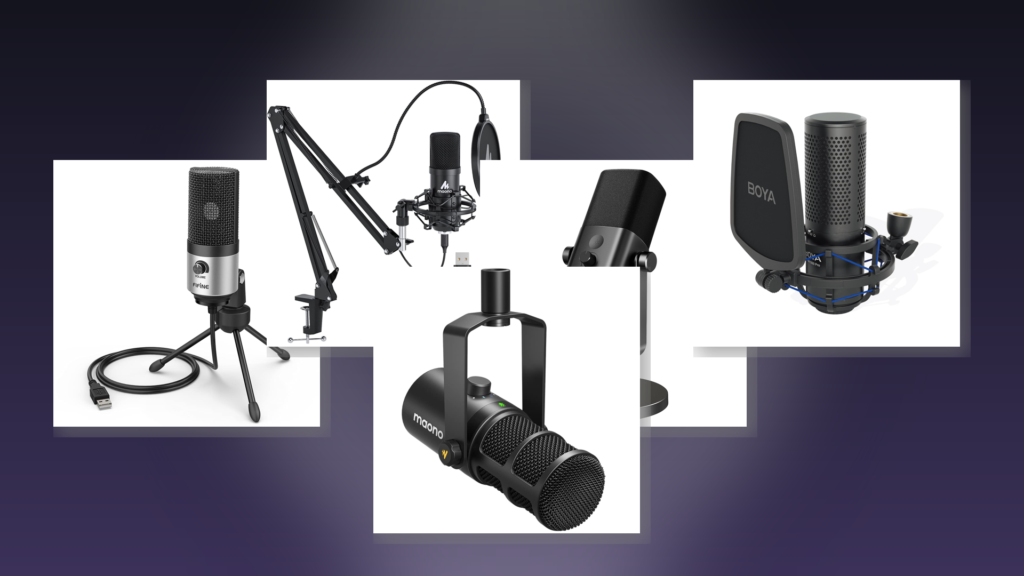
Our Top Picks
- Best Overall: Maono PD400X USB/XLR Dynamic Microphone
- Best Professional: Boya BY-M1000 + Focusrite Scarlett Solo
- Best for Streaming: Fifine AM8 USB Dynamic Microphone
- Best Budget: Maono AU-A04 USB Microphone Kit
- Best Beginner: Fifine K669B USB Condenser Microphone
Best Podcast Starter Kits in India — Comparison Table
| Product | Type | What’s Included | Best For | Check Price |
|---|---|---|---|---|
| Maono PD400X | Dynamic (USB + XLR) | Mic, desk stand, cables | Solo podcasters, hybrid users | [Check Price on Amazon] |
| Boya BY-M1000 + Scarlett Solo | Condenser XLR + Interface | Mic, interface, software bundle | Professional audio, interviews | [Check Price on Amazon] |
| Fifine AM8 | Dynamic USB | Mic, desk stand, pop filter | Streamers, live recording | [Check Price on Amazon] |
| Maono AU-A04 Kit | Condenser USB | Mic, boom arm, pop filter, shock mount | Beginners, complete kit buyers | [Check Price on Amazon] |
| Fifine K669B | Condenser USB | Mic, desk stand | First-time podcasters | [Check Price on Amazon] |
Top 5 Podcast Starter Kits in India — Full Reviews
1. Maono PD400X — Best Overall Podcast Mic for Indian Creators
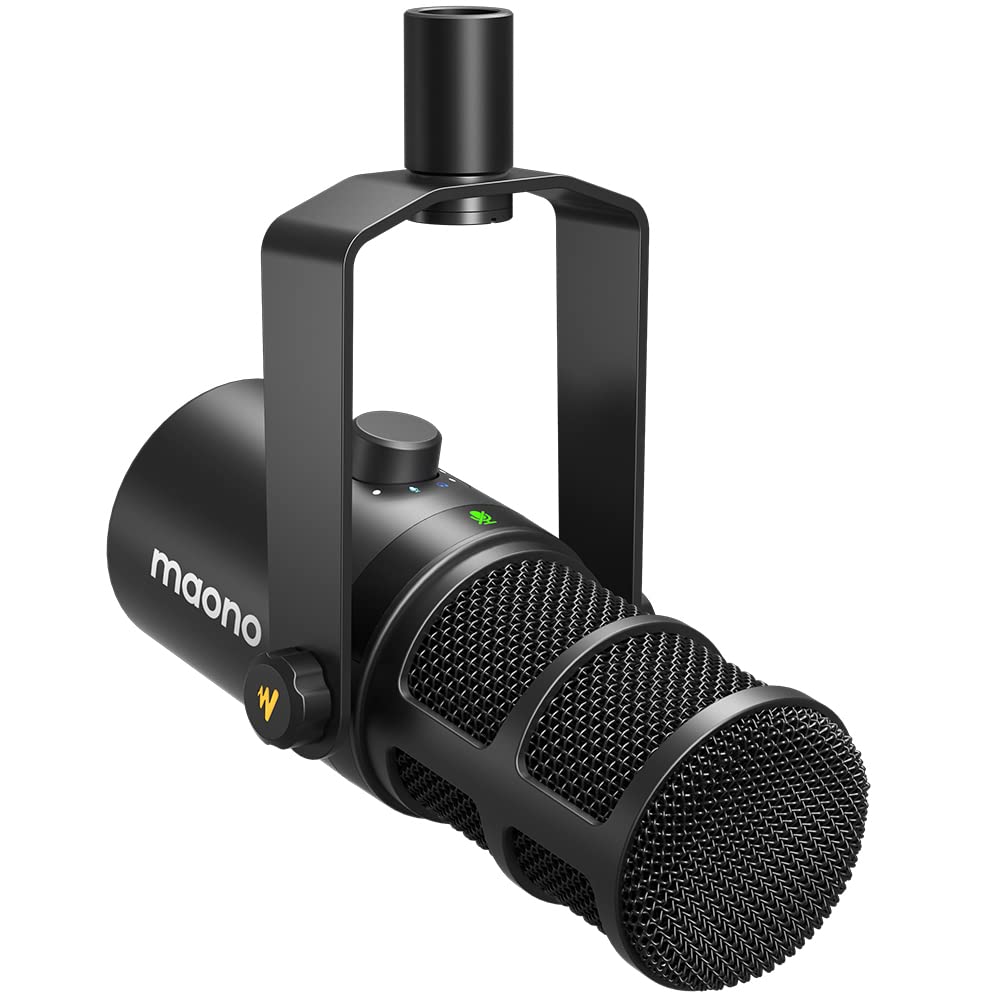
The Maono PD400X is the smartest buy on this list — not because it is the cheapest or the most feature-packed, but because it solves the biggest problem most Indian podcasters face without forcing you into a corner. It is a broadcast-style dynamic microphone with both USB and XLR outputs built in. Use it as a plug-and-play USB mic today. Connect it to an audio interface six months from now when you are ready. You will not need to replace it at either stage.
Dynamic microphones have a practical advantage in Indian home setups that most reviews written for Western creators completely ignore. Condenser mics pick up everything — ceiling fans, traffic, conversations through walls, the pressure cooker downstairs. A dynamic mic is far more focused. The PD400X captures your voice clearly and rejects almost everything else, which in a typical Indian room is the difference between a listenable podcast and a recording you are embarrassed to publish.
The mute button with LED indicator on the mic body is a small detail that matters a lot in practice — especially during live recordings or Zoom calls where cutting your mic quickly is essential. The built-in headphone amp with direct monitoring lets you hear yourself in real time without latency, which is something many mics at this level skip.
Features
- Dual USB and XLR output — no interface required now, fully compatible when you add one later
- Dynamic capsule with excellent off-axis rejection — handles noisy rooms better than most condenser alternatives
- Built-in headphone jack with mix control between mic input and playback
- Physical mute button with LED status indicator
- Internal shock mount and pop filter — no extra accessories needed
Pros
- Works immediately as a USB mic with zero setup
- Grows into an XLR setup without needing a replacement
- Dynamic capsule genuinely handles India’s noisy home environments
- Mute button and real-time monitoring are genuinely useful in daily use
Cons
- Dynamic mics require closer mic technique — you need to speak within 15–20cm of the capsule
- Less sensitive than condenser mics in acoustically treated environments
Bottom Line: If you are buying one mic and you want it to serve you across multiple stages of your podcasting journey, the PD400X is the answer. It is the most future-proof recommendation on this list.
[Check Price on Amazon]
2. Boya BY-M1000 + Focusrite Scarlett Solo — Best Professional Setup
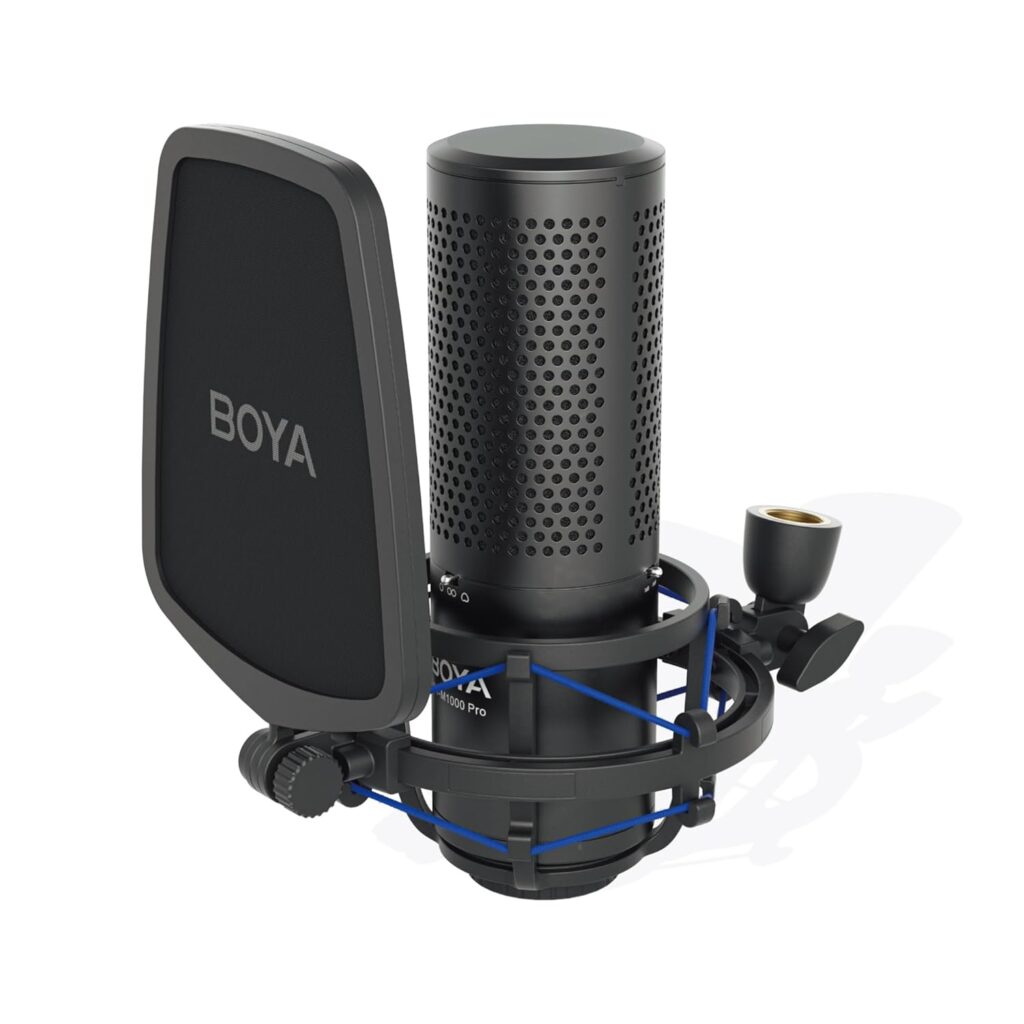
This is where the audio quality conversation changes completely. The Boya BY-M1000 is a large diaphragm condenser microphone — the type of mic that picks up the warmth, depth, and texture in a voice that smaller capsules cannot reproduce. Paired with the Focusrite Scarlett Solo, which is the most popular entry-level audio interface in India for good reason, you get a broadcast-quality XLR chain that produces audio most listeners will immediately recognise as professional.
The Scarlett Solo handles analog-to-digital conversion at 24-bit/192kHz and delivers the 48V phantom power that condenser mics require to operate. Focusrite’s preamps are clean and transparent — they add gain without adding color or noise, which is exactly what you want from an interface at this level. The Creative Pack software bundle that ships with the Scarlett gives you access to professional DAW software, which is genuinely useful if you are not already set up with recording software.
The BY-M1000 offers three polar patterns — cardioid, omnidirectional, and bidirectional — which gives you flexibility for solo recording, room ambience capture, and two-person interview setups without needing a second microphone. This is the combination you choose when audio quality directly affects how your brand is perceived.
Features
- Boya BY-M1000: Large diaphragm condenser with three switchable polar patterns
- Focusrite Scarlett Solo (4th Gen): USB-C, 24-bit/192kHz, 48V phantom power
- Direct monitoring on the interface for zero-latency playback
- Focusrite Creative Pack included — DAW software, plugins, and samples
- Scarlett Solo compatible with any XLR mic you upgrade to in the future
Pros
- Audio quality is in a completely different tier from USB mics at any price
- Scarlett Solo is a long-term investment — works with any future XLR mic
- Multiple polar patterns add versatility for different recording scenarios
- Software bundle adds immediate value beyond the hardware
Cons
- Condenser mic picks up room noise — acoustic treatment helps significantly
- Requires XLR cable and a boom arm, purchased separately
- Higher combined investment than USB alternatives
Bottom Line: If you are serious about audio quality and you want a setup that will still be serving you three years from now, this combination is worth every rupee. The Scarlett Solo alone is a piece of equipment you will never need to replace.
3. Fifine AM8 — Best for Streamers and Live Creators
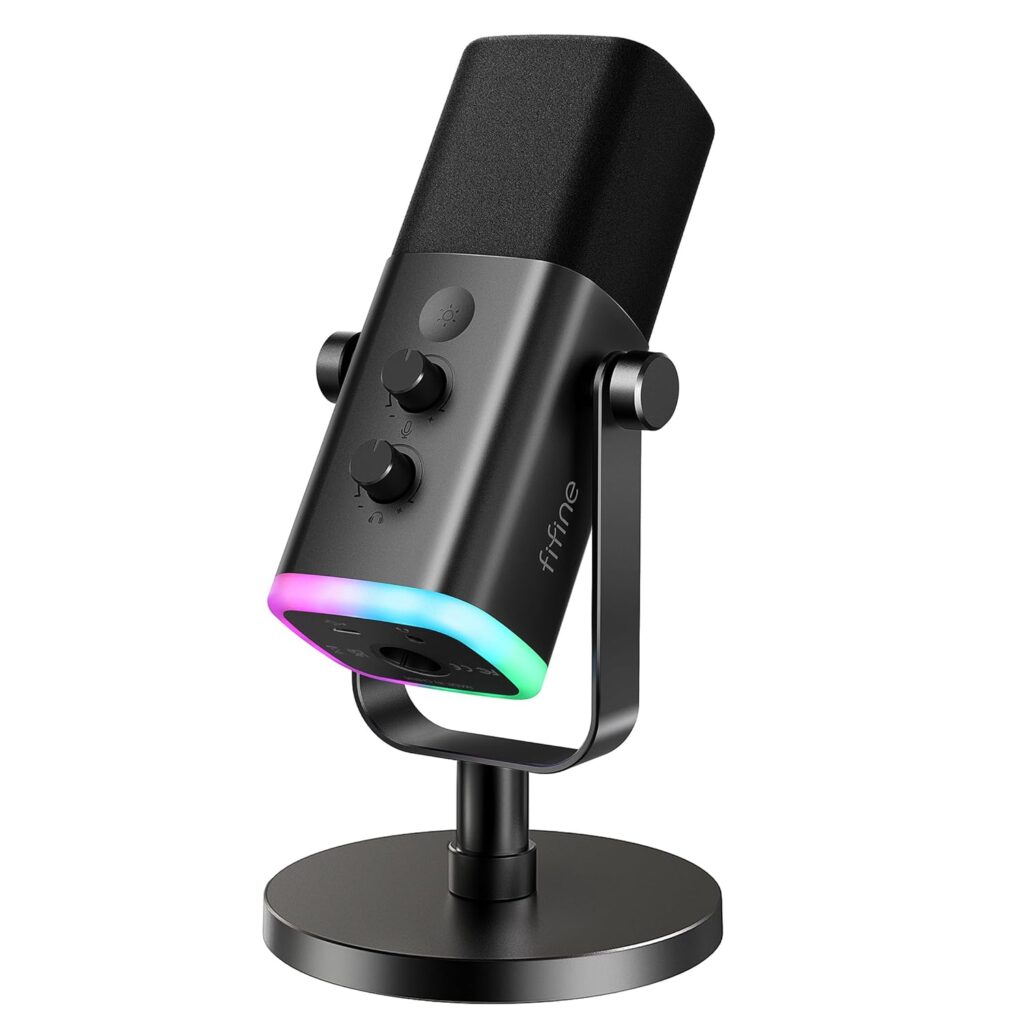
The Fifine AM8 is built specifically for creators who are recording live — streamers, gaming commentators, and anyone whose audio needs to be clean and consistent without constant monitoring or adjustment. It is a USB dynamic microphone with a cardioid pickup pattern, a physical mute button, a tap-to-mute function, and real-time headphone monitoring built directly into the mic body. Everything you need for live session control is within reach without touching your keyboard.
What makes the AM8 stand out for streaming specifically is its dynamic capsule. In a setup where you have mechanical keyboard noise, PC fan noise, and ambient room sound competing with your voice, a dynamic mic rejects off-axis noise far more aggressively than a condenser. Your voice comes through clearly. The background does not. For a streamer, that is the most important thing your microphone can do.
The build quality is solid for the price — metal body, stable weighted base, no wobble. It connects via USB-C and works across PC, Mac, and PlayStation without drivers or software installation.
Features
- USB-C dynamic cardioid microphone — plug and play across all platforms
- Physical volume knob and tap-to-mute button on the mic body
- 3.5mm headphone output for zero-latency direct monitoring
- Gain control knob for adjusting input sensitivity
- Weighted metal base — stable on desk without a separate arm
Pros
- Dynamic capsule handles gaming and streaming environments well
- Tap-to-mute is genuinely useful during live sessions
- No drivers needed — recognized immediately on all platforms
- Competitive build quality for its category
Cons
- Not as detailed or warm as condenser mics for studio podcast recording
- Desk stand limits positioning compared to a boom arm setup
Bottom Line: The AM8 is the most practical choice for streamers who want a dynamic mic with full session control at a price that makes sense. It does exactly what it is designed to do.
4. Maono AU-A04 USB Kit — Best Budget Complete Kit
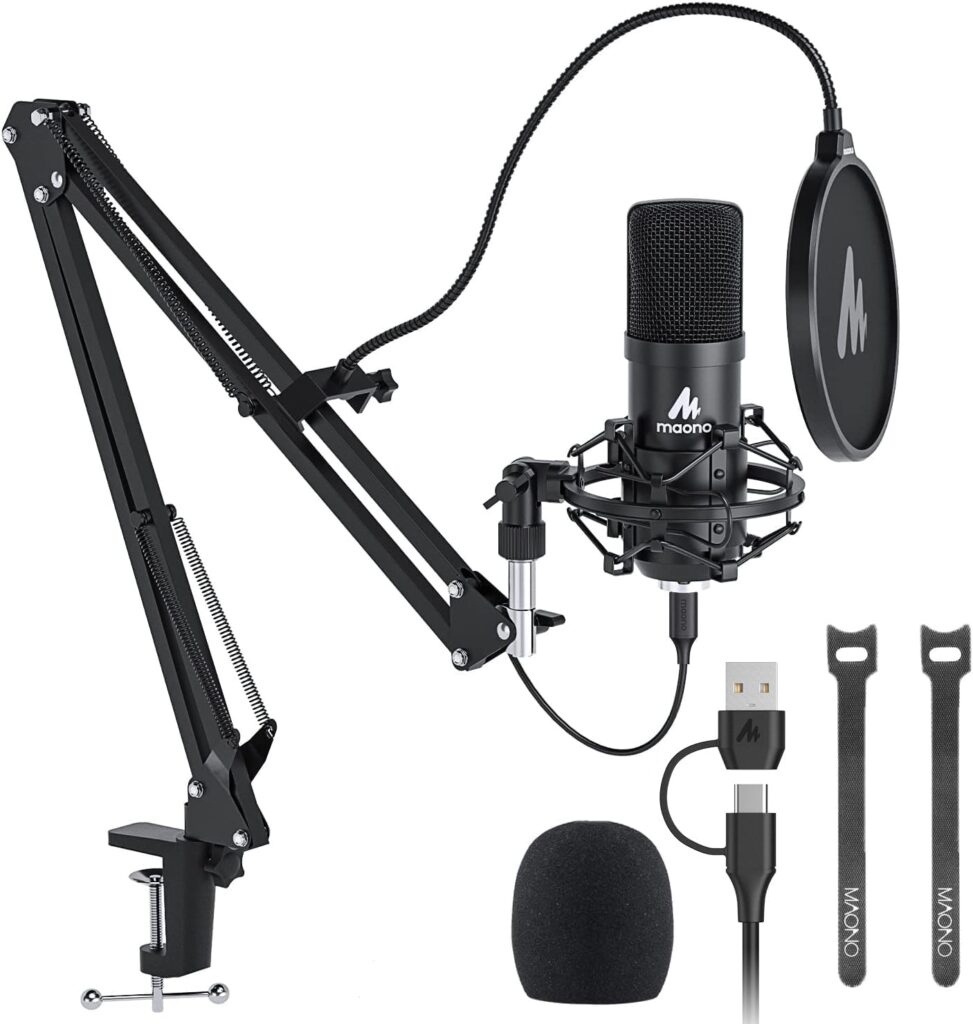
The Maono AU-A04 is the recommendation for anyone who wants to start recording today without figuring out compatibility, accessories, or what goes with what. Everything is in the box — a cardioid condenser microphone, a scissor boom arm that clamps to your desk, a shock mount, a pop filter, and a USB cable. Open it, clip the arm to your desk, attach the mic, plug in the cable, and you are recording. There is nothing left to buy and nothing left to figure out.
The audio quality is genuinely good enough to build an audience on. It is not competing with XLR setups, but for a first podcast, a YouTube voiceover, or online classes, it sounds clean and clear. Thousands of Indian creators have started on this exact kit. It is a proven entry point.
The boom arm is the weakest part of the package — the joints can loosen with heavy daily use over time. That is the honest trade-off for a bundled kit at this price. When you outgrow it, upgrade the arm. The microphone itself will hold up well.
Features
- Cardioid condenser capsule — focused pickup, reduces room noise
- 16mm diaphragm, 192kHz/24-bit USB audio
- Scissor boom arm with desk clamp included
- Shock mount and pop filter included — ready for professional-style positioning
- Compatible with Windows, Mac, PS4, and Android via OTG
Pros
- Genuinely complete kit — no additional purchases required
- Works immediately with zero setup complexity
- Good audio clarity for a first recording setup
- Boom arm positioning gives you more flexibility than a desk stand
Cons
- Boom arm build quality is the weak point — joints can loosen over time
- Condenser capsule picks up background room noise in untreated spaces
Bottom Line: The AU-A04 is the easiest recommendation for a beginner who wants a complete, functional setup without spending time researching compatibility. Start here. Upgrade when you are ready.
5. Fifine K669B — Best for First-Time Podcasters
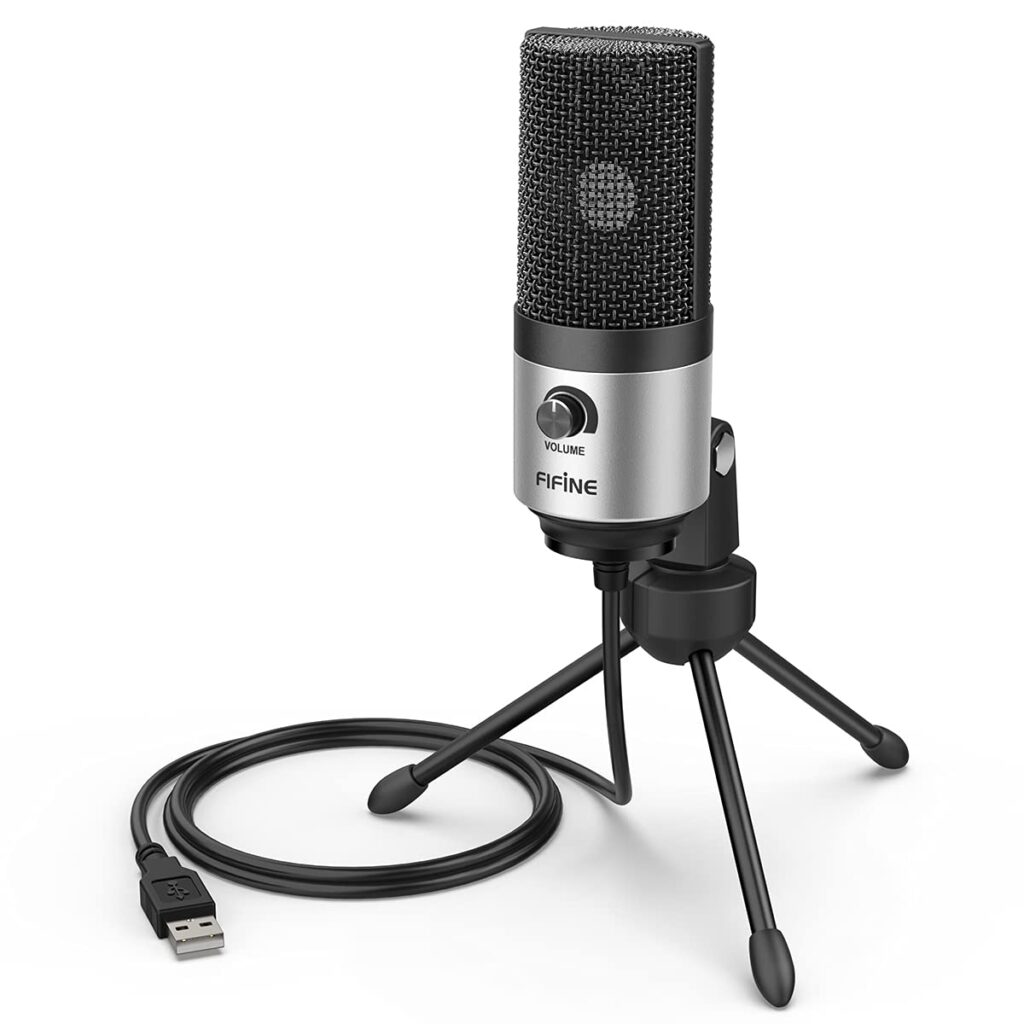
The Fifine K669B does not come with a boom arm or a pop filter, but it makes up for that with noticeably better audio quality than most mics sold at a similar price. It is a side-address cardioid condenser microphone — meaning the capsule faces the side of the body rather than the top — which is actually a better design for desk recording because it puts the most sensitive part of the mic naturally facing your mouth when the stand is on your desk.
The metal construction feels solid and the desk stand is stable. The volume control knob on the mic body is a small but useful feature for quick adjustments without going into your system settings. The 3.5mm headphone output with zero-latency monitoring is the standout feature for a mic at this price — it lets you hear exactly what is being recorded in real time, which helps you catch positioning issues and room noise before they make it into your file.
If you already have a pop filter or a boom arm from another setup, the K669B pairs well with both. If not, a basic pop filter adds a few hundred rupees and makes a noticeable difference.
Features
- Side-address cardioid condenser capsule — natural desk positioning
- USB connection with built-in sound card
- Volume control knob directly on the mic body
- 3.5mm headphone output with zero-latency direct monitoring
- Sturdy metal desktop stand included
Pros
- Cleaner, more natural audio than most mics competing in this category
- Real-time headphone monitoring is rare and genuinely useful at this price
- Metal build feels durable and is stable on a desk
- Side-address design works naturally in a standard desk recording position
Cons
- No pop filter included — a necessary additional purchase for recording vocals
- Fixed gain with no sensitivity adjustment on the mic itself
Bottom Line: The K669B is the right call for a first-time podcaster who wants better audio than the typical entry-level kit without paying extra for accessories they do not yet know how to use. Clean, simple, and genuinely good.
Podcast Starter Kit Buying Guide (2026)
USB vs XLR
USB microphones connect directly to your laptop with a single cable. No additional hardware, no setup, no compatibility questions. They are the right choice for most beginners and a large number of intermediate creators who want simplicity. XLR microphones connect through an audio interface, which handles the conversion from analog to digital. The audio quality ceiling is higher, and every component — mic and interface — can be upgraded independently. If you are thinking seriously about the long term, XLR is the more scalable choice. If you want to start recording this week without friction, USB gets you there faster.
Do You Need an Interface?
Only if you are using an XLR microphone. The interface provides the preamp gain and phantom power that XLR condenser mics require to operate. If you are on a USB mic, you do not need one. The Maono PD400X is worth mentioning here specifically — its dual USB/XLR design means you can start without an interface and add one later without replacing the mic.
Beginner vs Pro Setup
A beginner setup is a USB mic, a stable stand, and a pop filter. It gets you recording immediately and produces results that are good enough to grow an audience. A professional setup adds an XLR microphone, a quality audio interface, a boom arm, and some basic acoustic management. The jump in audio quality is real and noticeable. Most creators make this transition naturally as their channel grows — there is no reason to rush it or feel behind for starting simple.
Room Basics
No acoustic treatment budget is not a problem. Recording inside a wardrobe surrounded by hanging clothes is genuinely effective — the fabric absorbs echo better than most foam panels sold online. Avoid empty rooms with hard walls, tiled floors, or high ceilings. Keep your mic close — 15 to 20cm from your mouth — speak toward the capsule, and use noise suppression in Audacity or Adobe Audition to clean up what remains. Mic placement solves more problems than equipment upgrades.
Final Verdict
Best Overall: The Maono PD400X. It handles noisy Indian home environments better than a condenser, works as a USB mic immediately, and connects to an interface later without needing to be replaced. The most practical single purchase on this list.
Best Budget: The Maono AU-A04 Kit. Everything you need is in the box, it works on day one, and the audio quality is solid enough to build a real audience on. Start here and upgrade when the time is right.
Best Professional: The Boya BY-M1000 with the Focusrite Scarlett Solo. When audio quality is directly connected to how your brand is perceived, this is the combination that delivers. The Scarlett Solo is a piece of kit you will still be using years from now regardless of what mic you pair it with.
The right setup is the one that matches where you actually are right now — not where you want to be eventually. A beginner who starts with a solid USB mic and publishes consistently will always outperform someone with a professional XLR chain who is still waiting for the perfect conditions to record.
Pick the kit that fits your current needs, get your first episode out, and upgrade when the setup becomes the limitation. The gear matters — but it matters a lot less than actually starting.
You can also read 5 Best Ring Lights for YouTube (2026): Top Picks for Content Creators